
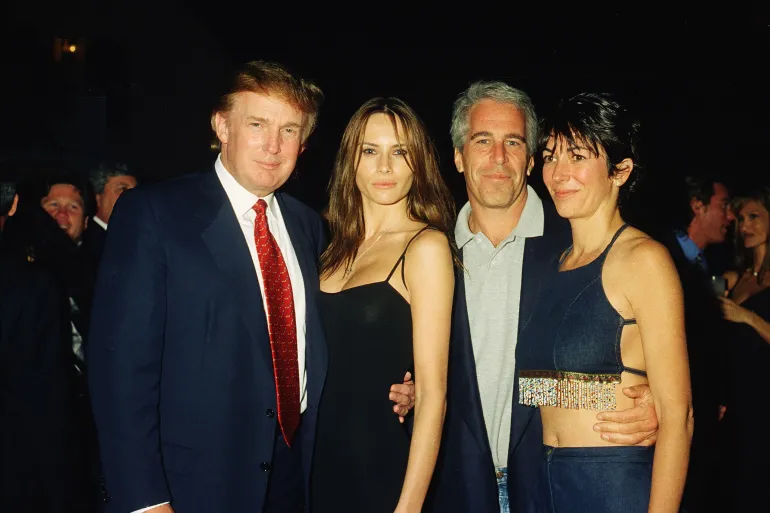
For almost a decade now before the Epstein Files, but some would argue a lot longer, we’re living in the “post-truth” era. If you ask ChatGPT, the post-truth era is a cultural and political condition in which objective facts and truth matter less than emotional appeals, personal beliefs, or ideological narratives. In this era, truth becomes fluid, and public discourse is shaped more by spectacle, tribal loyalty, and viral misinformation than by evidence or rational debate.

But the issue is also something else. The fact that nothing could be true leaves us starving for something that is “true” and really based in reality. And more than 40 years ago French philosopher Jean Baudrillard argued that the media, with the constant influx of information, images, and news creates and represents a reality without this something “really based in reality”.
He called this condition “hyperreality” – a society in which media messages, images and their repetitiveness create a simulation of meaning.
In my opinion, this sentiment-focused, simulated and (crucially) algorithmically delivered messages create the underlying logic of the post-truth era: “just because something isn’t true, it doesn’t mean it couldn’t be true”. Or, for example, just because Trump or Hilary are not in those files, it doesn’t mean they’re not capable of doing it, or have actually done it, just not with Epstein.
Because, in the end, I like this, so the brain gravitates towards it regardless, a phenomena known as cognitive bias.
This results in distrust, disgust and apathy (or maybe more precisely: the impossibility to do anything about anything), making us seek cathartic content to vent out at least a bit at the other side.
But the Epstein Files controversy marks a specific moment in contemporary media culture where the majority of the public’s interest is not divided in a typical “left and right” discussion. This is streamlined by the strong moral non-ambiguity on the topic (we don’t need a lot of discussion to reach a consensus that pedophila and human trafficking are bad) that overrides the usual partisanship bias (making this issue more of an “elite vs us”).
But there is also something else in this story that makes it unique. It builds upon years of hyper-real political content, where we do know the meaning, but we don’t really know what the meaning refers to exactly. Furthermore, the Epstein Files were a strong promise point of the Republicans – their request for transparency and justice, and “clearing out the swamp” was epitomized by this case. The crucial issue of trust in the government and/or the media is at stake here.
And as we’ll see, the current events are a culmination of years of sentiments, facts, fiction, and their meanings all converged into one single hyper-real point – The Epstein Files.
The Occult Elite and The Powerless Everyday Person
Historically, within what we recognize as Western thought, the idea that powerful individuals inevitably succumb to lust, perversion, and obscenity has been a persistent one.
Examples such as Solomon forsaking God because of his harem, the incestous Borgias organizing orgies in the Vatican, or more recently the Dubai “potty mouth” trend fascination – all point to close relationship of power and sex. This perception is, in my opinion, horribly harmful for both sex and power, but it undeniably has roots in real social dynamics and human psychology.
Building upon this, in the U.S. media culture, there has been a niche but strongly impactful idea of “the satanist/occult elite sexually exploiting minors” narratives. Examples like the Twin Peaks and True Detective first come to mind.
Twin Peaks, in this regard too, is special. While we’re catching the killer, we’re diving deep into the “soul” of the U.S., pointing to all the factors that created the conditions where such an evil act could take place. It also shows how a pure soul can create unhealthy, harmful habits, and finally, it offers a glimmer of tangible hope usually ascribed only to religions.

True Detective was, despite numerous occult references, far less mystical in its message. It was a lot more real – it showed “the occult” for what it really is in most cases. The occult of True Detective realism is one where spirituality serves as an ideological/psychological justification for most vile and cruel acts upon others, or a perverse, sadistic fetish. The uncanniness of the narrative is highlighted by morally ambiguous protagonists and villains hiding in holy places.
And again, this is not just a random association. Cults have been a noticeable factor of the US’s cultural history, making a significant impact on the Western collective imagination. The idea of rich, powerful men seeking another thrill in the forbidden or transcendental is not just of sexual lust, but there’s an implied desecration of what human values are.
Cynicism and reality aside – children, for most of us, represent the ultimate potential; vulnerable, naive, unsullied-by-the world, good, innocent, bearers of all the human potential. At that point, pedophilia becomes not just a crime, but also something anti-human, demonic, un-holy that upsets us more than other atrocities.
Let’s zoom out for a bit: it’s not like the sex trafficking/pedophilia are necessarily linked with the occult, even if the acts themselves do seem evil. Recently, the Diddy trial also showed a world where rich and powerful exploit, rape or brutalize humans. The (conspiratorial) evidence was then marked as “Diddy tapes” – a shorthand for rumored incriminating video evidence.

And just like the Epstein case, the very fact that Diddy was doing all these things is what enabled him to stay in the position of power for so long. Diddy himself, the implication of this story goes, created stars on his will precisely because he either sexually used them, or enabled them to sexually abuse others. Of course, before Diddy, there was the Harvey Weinstein trial.
…
This all points to something else. The USA (and worldwide) elites are ready to pay a high price to fulfill their sexual fantasies, no matter how messed up they are. Humans, children, and especially women, and especially women of lower economical/social background – are a commodity. This commodity reaches a high price, so obviously it’s available only to the rich and powerful.
Why Is It Different This Time
Prior to the Epstein Files, these ideas also had a real-life political narrative, the conspiracy theory known as the Pizzagate scandal. This theory originated during the 2016 U.S. presidential elections, after WikiLeaks published hacked emails from Hillary Clinton’s campaign chair, John Podesta. Internet users on forums like 4chan and Reddit claimed that mentions of food were a secret code for child trafficking. It has since been a landmark on how a conspiracy theory can come to life.

The theory spread widely online and led to a real-world incident where a man fired a rifle inside the restaurant, believing he was rescuing children. Pizzagate later evolved into the broader QAnon movement, which has been embraced by parts of the Republican base and continues to promote conspiracy theories about secret elites and child exploitation.
Indeed, it is this base of supporters that makes the Epstein Files relevant now.
By converging the narrative of the Pizzagate with the Epstein Files, two things happened at the same time: the obscure political theory gained legitimacy and its representatives in the Republican party (QAnon); a real case got attached to a number of surplus meanings associated with these topics.
To clarify: I’m not claiming that TV shows like True Detective spoke about this literally. I am also not saying that the fact that “Diddy Tapes” and “Epstein Files” exist as a topic makes them real; or that the political narratives now are a continuation of cultural imagination, a fantasy for those in need; nor that the Pizzagate was just an exaggerated version of the truth that is verifiable in the Epstein Files.
What I wanted to highlight is that the different meanings of fiction, facts and sentiments circulating in the media have come to a single, tangible point.
Indeed, this convergence of the factual, assumed, and fictional is what gave a legitimate power to the MAGA movement; this is why people voted for them. The issue for them is not just “who is on the list”, or that Trump and Epstein are connected. Even if a lot of powerful people are incriminated, they’d at least be on a clean slate with it and could still be the legitimate representatives of the people who voted for them.
Their issue is much more serious: if the list doesn’t exist, contrary to what they previously insisted, what gives them a legitimate claim to power positions?

Or, to go a step further: if there is no deep state that protects the abusers, within their own narrative, it means that the Republicans are the deep state.
How to understand this situation right now?
We’re Living a Simulation Of Meaning
Jean Baudrillard’s concept of simulation refers to a state in which representations no longer reflect reality but replace it entirely.
In his view, modern society is dominated by images, signs, and media that create a hyperreality. This is a world where the distinction between the real and the artificial collapses. Rather than mirroring reality, simulations become self-referential systems that produce their own version of truth, causing reality itself to implode into signs.
It’s important to note here that the media are not just the television houses that made TV series or political shows. Nowadays, they’re also the algorithmically delivered content from YouTube, Twitter, Google, Facebook.
And signs are, to be specific, words, images, memes, hashtags, viral content – something that should be a representation of reality – not the reality itself.
And these are the Epstein Files. Epstein Files represent hard, tangible proof of everything wrong with the corrupted elite. But much more accurately, the Epstein Files are a simulation of that specific meaning with the attached meanings of the whole media totality related to these issues. We don’t know exactly what The Epstein Files are – tapes, documents, letters, names, photos – but we do know everyone knows about them.
And indeed, the FBI cabinet, Pam Bondi, Donald Trump are all currently experiencing the implosion of meaning of the Epstein Files.

So what does this tell us?
Firstly, it gives a good explanation on why we feel so powerless despite the freedom to talk about these issues – because we’re communicating with the media, addressing images, chasing narratives instead of the actual truth. We can never address the frame maker.
Secondly, the “actual truth” is elusive, because by its simulated nature, the original (that is, what should have been represented in the first place) is never what was represented. The “actual truth” might not exist at all.
At this point “the truth” becomes a matter of narrative control, not evidence based in reality. And who controls the media, controls the narrative. We consume “the truth”, our truth, as we’d prefer it, as we see it, but it’s just another content floating around in the internet.
We can see now why the importance of TV series and actual events interact and get flattened into a similar level – in the end, all of it is just content for consumption. We can save Laura in the same level as we can save the Epstein island victims.
And while we reference thousands of victims, while we think and we really do perform a quest for justice, there’s a strong cynical point to be made here: all we actually do is create yet more content to satisfy our needs without ever threatening the perpetrators. In that sense, even if they are published, the Epstein Files just hide the impossibility of justice for the victims.
The MAGA movement, QAnon, and conspiracy-driven politics are not born out of ignorance (or not solely out of ignorance, to be more precise and honest), but also out of the unbearable saturation of meaning, where people cling to whatever narrative feels emotionally real, meaningful, regardless of its factual basis.
And in this terrain, truth becomes less important than symbolic alignment of content: it’s not about justice, and more about who is allowed to claim the role of victim, or the savior of the powerless people.
So Is It Really Different This Time?
No.
The actual ability to do anything would mean a total reorganization of the whole media system and our democracies along with it. And while the current political unification of both Left and Right might exert pressure to release the Epstein Files, whatever those might be, it also makes the topic far more interesting for the wider public. This makes it a far more lucrative content to publish in terms of attention and visibility.

And it’s very telling that the story gained traction with Elon Musk and his media platform X. He’s already converting these narratives into political capital – how all of this will develop remains to be seen. But for me, it’s really difficult to believe that he has humanity’s best interest in his claim.
And maybe we will see some changes, maybe we’ll see the evildoers go to jail, and maybe we’ll hear and learn from the experiences of the victims and improve our societies based on what we have learned. Maybe some justice will be made.
It matters because in the end, it was real humans that suffered, not signs, images or content.
It’s the real humans that suffer.
